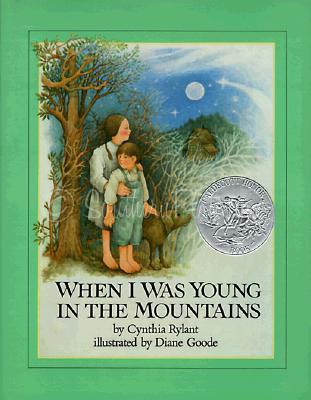
After reading Cynthia Rylant's The Old Woman Who Named Things, I thought I had a feel for her writing style and what the majority of her books would be like, but I was wrong. Although When I Was Young in the Mountains also had an old woman featured as a character, the two stories remain very different. This story has a different overall feel to it - much more nostalgic than The Old Woman Who Named Things.
Throughout the book, the title is used over and over again, nearly at the start of every other page, which simply reinforces the nostalgic feeling of the book. Rylant takes the reader back to a time when things were simpler, when summers were spent with grandparents in the mountains, when butter was picked up from neighbors on the way home, when cousins were baptized in the murky water of the swimming hole, and when nights were spent sitting on the porch shelling beans and getting hair braided by Grandmother.
Although most children aren't able to remember a time like this, many adults who read this book will remember a simpler time - a time where iPhones weren't owned by children in 5th grade, when being removed from technology for the summer wasn't abnormal, and when afternoons were spent pumping water from the well. And although I don't remember a time like this, it does take me back to hearing about my father's childhood in rural Virginia and summers spent working with his cousins on our family tobacco farm.
When I Was Young in the Mountains has potential to bridge the gap between children and their grandparents, but also, more importantly, gives children at any age a peek into what life was like in the earlier days. The illustrations throughout the book fit incredibly well with both the rhythmic nature of the text as well as the purity and almost plainness of life in the mountains. The pictures also show the power of touch, whether it is the sweet grasp depicted on the front cover from sister to brother and brother to dog or the gentle hand hold by Grandmother escorting her granddaughter to the "johnny-house" in the middle of the night because she is scared.
It is clear to see why this book won the Caldecott Honor - there is beautiful and near-perfect integration of a love of family, a harkening back to older and simpler times, fitting and breathtaking illustrations, rhythmic text, and an overwhelming feeling after reading of happiness and nostalgia.
When I heard I had to read two picturebooks by Cynthia Rylant, I thought the choice would be easy. "No one could have written that many picturebooks," I thought to myself. However, I was wrong. Because when I went to find merely two picturebooks by Cynthia Rylant, I was caught in a sea of choices and quickly realized that Cynthia Rylant has written more than 100 books for children in her lifetime. How was I simply supposed to choose two out of 100 on Amazon to order? I settled down with one to start - The Old Woman Who Named Things and the beauty that Rylant used to delve into a sad and somewhat depressing issue was incredibly impressive.

Although the book is entitled The Old Woman Who Named Things, ironically enough, the old woman is never designated with a name. But somehow, that makes the story more relatable, more personal, and makes me think that that was a strategic move on Cynthia Rylant's part. That move makes each individual reader feel as if the old woman could be anyone - a great-grandmother, an older woman you know in your church congregation, or a family friend - not just one specific person.
Tackling a subject matter like outliving all of your friends (because you're simply so old that all of them have died) isn't an easy one. And it most definitely isn't an easy one to tackle in a children's picturebook. But Rylant does it with ease - and makes each reader want to name the things in their life and appreciate the "relationships" they have with their own Betsys, Franklins, Roxannes, and Freds, but also truly value the personal relationships that they have as well.
My favorite part of the picturebook is the personal transition that we see the old woman go through - from being a person who strives to actively not make relationships with living things to being a person who travels outside of her comfort zone and becomes vulnerable in her relationship with a puppy. I can imagine what a sentimental attachment early elementary school students could form with the old lady in the book, and this book has the potential to be one that is so loved that the pages are tattered and dogeared with love.