Monday, July 30, 2012

Hattie Big Sky - Kirby Larson

Why all this fuss about where someone was born? 
Wasn't it where he lived - rather, how he lived - that counted? 
- page 61

Continuing with my love of historical fiction, I chose Hattie Big Sky by Kirby Larson as my third historical fiction required read. Although I didn't love this book quite as much as I loved Esperanza Rising, it's definitely a close second. Hattie Big Sky tells readers the story of Hattie Brooks, an orphan living with her ornery (yes, ornery is the proper word for this woman) Aunt Ivy and her sweet Uncle Holt. Despite Hattie's age of 16 and the fact that she hasn't completed school, her Aunt Ivy wants to send her to live in a boarding house to serve as a maid. Magically, Hattie receives her own version of a Hogwarts letter - a letter from her deceased uncle (Uncle Chester) in Vida, Montana, leaving a 320-acre claim of his homestead. Hattie jumps at the chance to move out of her relatives' house and sets off to move to the homestead. What follows is her brief journey from Iowa to Montana and the struggles and heartwarming stories of her life 3 miles outside of Vida. 
Hattie meets a variety of people who impact her life in Vida: Mr. Ebgard - the lawyer in charge of carrying out her uncle's estate; Perilee and Karl Mueller and their children Chase, Mattie, Fern (and later on Lottie) - her neighbors; Traft Martin - the 20-year old son of the richest family in town; Rooster Jim - her chess-playing, bicycle-riding, chicken-raising neighbor; and Leafie - a hardcore woman who can hang with the best of them. All of these people have an impact on Hattie, whether it is one that will last long after she leaves Vida (like Perilee) or someone who terrorizes her existence in his place in the community (like Traft's mother - Mrs. Martin, and often sometimes Traft himself). This book reminded me a little bit of the TV show (that was a family favorite) called Christy (for a clip of it, see here!). Hattie has the same spunk and perseverance that Christy had in the tv show and they're set in the same time period in rural areas. 
Hattie Big Sky was named a Newbery Honor Book in 2007 and I completely understand why. Both Kirby Larson's writing and the characters that she creates throughout the novel had me on the edge of my seat throughout all of the pages. I even cried, which I rarely do while reading books (although the fact that the last two I've read I've cried during doesn't help me - at least they were Hattie Big Sky and Esperanza Rising). This book would be a fantastic read-aloud book or a book club book. I think it would also be a fantastic opportunity to children to journal in a book journal about their reactions, because many of the chapters leave you hanging on the edge of activity. I would definitely recommend Hattie Big Sky for an elementary school classroom! 

Saturday, July 28, 2012

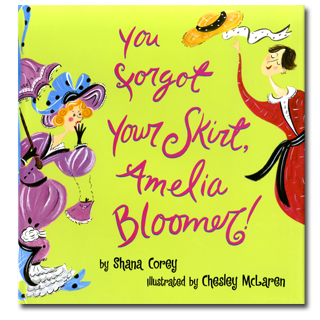
You Forgot Your Skirt, Amelia Bloomer - Shana Corey


"Thank goodness," they said. 
"Now everyone will forget this nonsense
and things can return to normal." 
But did people really forget about Amelia bloomer
and her improper ideas? 

This information book by Shana Corey (and illustrated by Chelsey McLaren) tells the story of the career of Amelia Jenks Bloomer, a women's rights activist and newspaper editor in the 1800's. I'll admit - I chose it mostly for the bright colors, the frilly dresses, and the subtitle, which was "You Forgot Your Skirt, Amelia Bloomer! - A Very Improper Story!" However, I was proven wrong. Although there are many frilly dresses in this book, the true reason for introducing those frilly dresses is to show how big of a deal it is when Amelia Bloomer chooses to give up wearing frilly dresses. 
Amelia Bloomer uses the phrase "What was proper about that?" throughout the first half of the book to emphasize how improper the actions that Amelia Bloomer performs are. She is the editor of a newspaper, which she names The Lily. How inappropriate for a woman to be the editor of a newspaper! She hated the dresses that women had to wear. She thought the dresses were inappropriate, and often uses the phrase "What was proper about that?" to describe the dresses themselves. Amelia's entire legacy rested on the fact that everyday, she asked the question, "What's proper about that?" whether it was about her clothes, about the rights that women didn't have at the time, or about the practicality of things. 
The REAL Amelia Bloomer
I think that this book also teachers children to question things and to embrace change, just like previous books (like The Giver and Among the Hidden), but not to the same extent. It's a book that has the potential to let children do these things at an earlier age, and I'm assuming that the target age audience of this book is early elementary. It would also serve as a fantastic resource in introducing historical figures in an interdisciplinary unit, as Amelia Bloomer was a women's rights activist, even if she ended up also being the woman responsible for introducing pants as a suitable bottom for women! (Hence the name bloomers, get it?). I thought this book was wonderful, and the author's note at the end is a history of Amelia Bloomer - from her birth in New York to her move to Iowa. One of my favorite quotes from the Author's Note is the very last sentence, which says: 
Today, women and girls can wear whatever they want. 
Perhaps it wouldn't be that way, though, 
if all those years ago Amelia Bloomer hadn't had the courage
to be "improper" and to take a stand
for something she believed in. 
Many books I don't consider worthy of reading the author's note, but this author's note not only adds to authenticity, but has the potential to spark even more interest in class-wide or individual research on women's rights. I think that that's research worth doing, and would love for all of the children in my class to enjoy and take interest in it. 

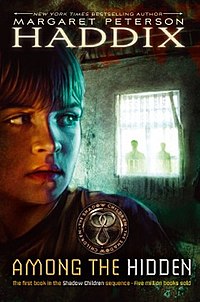
Among the Hidden - Margaret Peterson Haddix

No one had ever told him exactly what would happen if anyone saw him. 
Death? Death was what happened to the runt pigs 
who got stepped on by their stronger brothers and sisters. 
Death was a fly that stopped buzzing when the swatter hit it. 
- pages 3 & 4

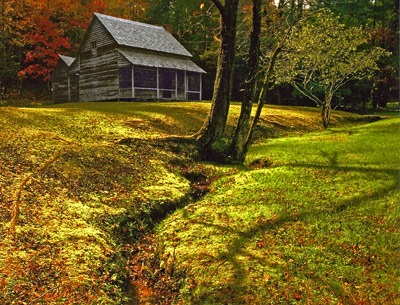
I never was much of a fantasy/science-fiction reader growing up, but reading a few fantasy and/or science-fiction books for this class has made me have a new found appreciation for the genre. This book is no exception. I love when I am able to have a concrete setting of the book in my mind, which means Margaret Peterson Haddix did an incredible job in her descriptions of what life in the woods was like. In my mind, the houses inhabited by Luke and Jen looked like this...
What I imagined Luke's house to look like

What I imagined Jen's house to look like
The book is set in a society that seems to be a possible one in the future, and it begins describing the everyday life of Luke, a 3rd child in a society that forbids parents from having more than 2 children. He is required to hide at all times. He cannot go out in public, cannot go to school, or do any of the things that his brothers do. This is all before the woods are taken down to make room for the "Barons" to move in - rich and wealthy families. When they move in, Luke is more confined, in an effort from his parents to make sure they aren't caught by the Population Police. Then, one day, Luke sees a suspicious light and movement in a house outside of his window when he knows all of the family members (4) are gone. He then realizes that there is another 3rd child. One day, he sneaks over and discovers Jen, a rambunctious, courageous, fearless "shadow child." She is in the midst of helping facilitate a rally against the government, which she encourages Luke to come to. She introduces him to the world, to history, to junk food, to "freedom." When she leaves for the rally, she encourages Luke to come, but he is too scared. He doesn't hear from her for 3 weeks and fearing the worst, heads to her house. Her father comes home, discovers Luke, and tells him that Jen has been killed. However, her father, despite a break-in from the Population Police, vows to keep Luke safe and help him get false identification. Him receiving his fake ID and heading off to boarding school as someone else is where we leave him at the end of the book, which is a series. 
Once I have time again, I'm definitely planning on reading the rest of the series, as I found this book incredibly interesting. There are six other novels in the series, which is named, appropriately, "The Shadow Children" series. I'm interested to see the other places that Margaret Peterson Haddix takes Luke and what other kinds of people he will interact with in the rest of the series. I'm also interested to see if characters like his mother, father, and brothers will return later on, or if his mother will complete her dream of having four boys named Matthew, Mark, Luke, and John by having another shadow child.
This book has the potential to bring up a lot of interesting issues in classrooms, and I think would be an ideal way to discuss different types of government in upper elementary grades. It's also simply a great thought-provoking book that has potential to make children question the norm and be more curious about the world. It brings up many of the same issues that books like The Giver does, but in a less overt way. The suspense in this book would also make it a great read-aloud, and I know that children would anxiously await the time of the day when the book was read. Isn't that what we want as teachers? 


Thursday, July 26, 2012

Clever Beatrice - Margaret Willey

Her mother would say that Beatrice was the
most clever girl in the whole north woods. 
Beatrice could not wait to hear it. 

I've had the book Clever Beatrice by Margaret Willey (and beautifully illustrated by Heather Solomon) sitting in my apartment since the start of class. It caught my eye in Swem Library in my original trek there to retrieve books and I finally got around to reading it. Clever Beatrice is categorized as a Canadian conte, which the author describes as follows - 
The upper peninsula of Michigan is rich and varied in the tradition of Native American and European folktales, including the Canadian conte. Like the Finns, Swedes, and Irish, French-Canadians were lured to northern Michigan by the lumber boom of the late 1800s. Canadian contes were told originally in lumber camps and iron mines and were known for wild exaggerations, comic detail, and rhythmic dialect. 
I had never heard of a conte before, but this tale seemed to be similar to what we've categorized in class as a tall tale. Regardless, the book was a pleasant one - short, sweet, funny, and a little fantastical. Willey starts the story with Beatrice, who is described as "sharp as a tack" and by people saying whenever she walked by - "She's a clever one, that Beatrice." Beatrice and her mother ran out of money and porridge, so they needed more money, but the only way in their community to get money was to be a lumberjack or to go bet against the giant. Beatrice decided to take her chances, and by outsmarting the giant and scaring him with her wit, she brought home a bag of coins for her mother. Then, the story ends. 
Clever Beatrice won the Charlotte Zolotow Award, which is awarded annually for a children's picturebook that contains excellent writing (age birth through age 7 is the typical age categorization for the picturebook). I found that interesting, because although I did enjoy this book, I didn't think it was anything spectacular. I think it could serve as a fantastic way to introduce tall tales or introduce different regional traditions in the United States, but I didn't find it nearly as interesting or beautiful as the writing in other picturebooks that we've read throughout the semester. If anything, I thought the illustrations of Heather Solomon deserved a Caldecott Medal. She seamlessly blended watercolor, collage, acrylic, and oils into a beautiful book. Her illustrations added significantly to both the relationship between Beatrice and the giant and to the overall folksy "feel" of the story. 
I think that this book is worth having in the classroom, but I don't know if I would go out of my way to read it aloud or to introduce it to children. With so much great literature out there that is inspiring, this fell a little bit short for me. 

Me...Jane - Patrick McDonnell

It was a magical world
full of joy and wonder, 
and Jane felt very much
a part of it. 

When you open up the pages of the book Me...Jane by Patrick McDonnell, you're transported into the childhood of primatologist Jane Goodall. Patrick McDonnell almost channels Cynthia Rylant a little bit in this biographical children's picture book - his language, the illustrations (the feeling they convey, not the illustrations themselves), the run-on sentences, and the short phrases on pages. The page that I most felt this similarity on was this one - 
I think that the repetition of "beating, beating, beating" is what truly made me compare it to Cynthia Rylant. Regardless, I loved this picturebook. It took me back to the days of movies like Gorillas in the Mist, Mighty Joe Young, I Dreamed of Africa, and Born Free. 
The true strength of this book was the illustration. It was simplistic, sweet, innocent, and beautiful. Jane and her stuffed chimpanzee are in every single illustration (minus the double spread of Jane's doodles and drawings of puzzles and societies), and this did two things for me as a reader: 1.) It made me realize how much Jane loved her stuffed chimpanzee, Jubilee; 2.) It made me realize how passionate Jane was and how determined she was to reach her goal of going to Africa and working with animals. 
I really loved the ending of this book, where it shows an illustrated Jane in a tent waking up for the day followed by the words "...to awake one day..." and met with a real-life picture of Dr. Goodall on the next page with the words "...to her dream come true." I think that this book would be fantastic for children in learning about animals, in learning about Jane Goodall, and even simply in learning about not giving up and continuing chasing their dreams. In the end of the book, there were two additional sections - an "About Jane Goodall" section and a "A Message from Jane" section. I loved the "A Message from Jane" section so much I just had to put some of it here. She writes, 
Each one of us makes a difference. 
We cannot live through a single day 
without making an impact on the world around us - 
and we have a choice as to what sort of difference we make. 
The life of each one of us matters in the scheme of things, 
and I encourage everyone, especially young people, 
to make the world a better place for people, animals, and the environment. 
Children are motivated when they can see 
the positive results their hard work can have. 
As I travel, I meet hundreds of Roots & Shoots groups. 
They are always eager to tell "Dr. Jane" what they've been doing 
and how they are making a difference in their communities. 
Whether they've done something simple, like recycling or collecting trash, 
or something that requires a great deal of effort, 
like restoring a wetland or raising money for street children 
or a local dog shelter, 
they are a continual source of inspiration for me 
and for other children around the world. 
I invite you to get involved!
What a cool way for Jane Goodall to make her voice heard to children who want to get involved. If you want to learn more about her organization, Roots & Shoots, check it out here. And I'll leave you with one of the pictures I took almost exactly 6 years ago early morning at Kruger National Park in South Africa - one of the sweet elephants I saw. It's not hard to think about why Dr. Jane is where she is.

Salt in His Shoes: Michael Jordan in Pursuit of a Dream - Deloris Jordan with Roslyn Jordan

After that day, Mama stopped putting salt in Michael's shoes, 
but Michael did not stop being patient and working hard and praying.

Salt in his Shoes is the biographical account of Michael Jordan's childhood and how he learned to be dedicated, to work hard, to be patient, and to love the sport of basketball. It's hard to think of Michael Jordan as a scrawny little boy living in Wilmington, North Carolina and struggling to keep up with the bigger kids on the basketball court. The book includes a lot of dialogue, particularly between Michael and his mother, who is the co-author of this book (along with his sister!). Michael's mom and sister tell the story of him playing basketball with his older brother and never being tall enough and praying every night to be taller. His mom told him that if he put salt in his shoes and prayed every night, he would hopefully become taller. And although he didn't become taller until the summer before his junior year of high school, he realized that if he worked hard, he could get where he wanted. 

I think that this book gives children a perspective into the life of Michael Jordan, and although he's retired from the NBA, he still is infamous for his incredible basketball skills, his dedication, and his magical story. It also lets children know that not everything happens simply because we wish for it. We have to work hard, be patient, and have faith that things will work out in the end. We have to work for it. Teaching children that lesson at an early age is incredibly important. While I was cooking dinner one night, I had a friend over to my apartment, and he picked up this book. Even at the age of 21, he sat and read the entire thing and then said, "Well, looks like I'm ordering this when I go home." He talked about how he wished he'd had that book in his classroom as a child. Because this book features such a prominent NBA figure who so many children know, I think it would be a fantastic book to get boys who are frustrated with reading in elementary school to read. 

The illustrations in the book are somewhat "old school" and really make the reader feel that they've been transported back in time to Michael Jordan's childhood, which I liked. I do think that they could have been a little less "cartoon-ish", however. Because Michael Jordan is such a well-known star, I knew what I expected the illustrations of his childhood to be like. And this wasn't what I pictured. It wasn't bad, but it just wasn't what I imagined it to be. The illustrator did do a fantastic job, however, of making sure that her version of Michael looked like Michael as a child, which I liked. 
This book provided a different feel to the biographies that I'm used to, and I liked it. I don't think it's the best book in the world, but I do think it's a great for helping incite reading in children who wouldn't normally care. 
And now, for a little MJ inspiration...

Esperanza Rising - Pam Munoz Ryan

"Look at the zig-zag of the blanket. Mountains and valleys. 
Right now you are in the bottom of the valley and your problems
loom big around you. But soon, you will be at the top of the mountain again. 
After you have lived many mountains and valleys, we will be together."
- Abuelita speaking to Esperanza, page 51

Very few times am I incredibly and utterly touched and impacted by a book. I fall in love with books easily. I read them like magazines, from cover to cover. Sometimes over and over again. But Esperanza Rising was one of those books that I will not hesitate to put in my classroom library. It is a book that I think could be incredibly powerful to read-aloud to 5th and 6th graders. And finally, it is a book that struck a chord with me. I'm sitting here, on my couch, after finishing the book, and am stunned by the beauty of the words of Pam Muñoz Ryan, smiling because I am happy for Esperanza, amazed that this is based on the story of Ryan's grandmother, and unabashedly touched by the overwhelming perfection of this book. 
When we talked about historical fiction in class yesterday, I didn't realize it, but it is by far my favorite genre of literature. Many of my favorite books growing up and as an adult have been historical fiction books - Number the Stars, Girl with a Pearl Earring, Gone with the Wind, Roots, The Kite Runner, O Pioneers!, and My Antonia. Now, I can without a doubt add Esperanza Rising to that list of favorites. Pam Muñoz Ryan tells readers the story of a girl named Esperanza Ortega who lives in Mexico in the 1930s and tells of her incredible journey of coming to America and coming to terms with the sad reality of her life. Esperanza is extremely close with her Papa, a big, burly man who spoils her rotten. 
Although the Ortega family is living in Mexico, they are extremely wealthy and Papa gives Esperanza everything she could ever want. When bandits kill Papa the night before Esperanza's birthday, her world begins to crumble, and we see many other things become difficult. Her trickster uncles (one - the mayor, the other - the head banker) will not give Mama and Esperanza the money they have in the bank and unless Mama gets married to one of them, they promise to make the Ortega's family life difficult. They do this by setting fire to the house in the middle of the night. This leads Esperanza and her Mama to realize that they must move to California with their servant's family - Hortensia, Alfonso, and Miguel. This only begins the journey that Esperanza goes on from being the queen of the universe to being a peasant. 
Bits and pieces of this book reminded me of The Little Princess, because it takes a girl who is extremely close with her father, strips the father away, and then puts her in servitude. However, with Esperanza, there is no coming back for Papa, whereas Sarah is reunited with her father in the end. The transformation that Esperanza goes through during this book is incredible, and as the reader, we are taken on a conflicting journey. We adore her and the life she has in the beginning. We become frustrated with her when she acts like a stuck-up princess on the train and insults Miguel. We feel embarrassed for her when Marta picks on her and shames her because she doesn't know how to sweep. We feel happiness for her when she becomes independent. We feel sadness for her when Mama becomes sick and must go to the hospital. But most of all, we feel hope for Esperanza, which is ironic - because in Spanish, Esperanza means "hope." I think that was purposeful - what a beautiful and literal representation of the possibilities that a life holds. 
The "Author's Note" in the back of Esperanza Rising is a documentation of the personal life of Pam Muñoz Ryan's grandmother and a description of how the book came to be. This represents and adds to the accuracy and authenticity of the text, something extremely important for historical fiction. It also introduces Pam Muñoz Ryan as a cultural insider because these are the tales of her grandmother, and is also a winner of the Pura Belpre medal, a medal given to "a Latino/Latina writer and illustrator whose work best portrays, affirms, and celebrates the Latino cultural experience in an outstanding work of literature for children and youth" (found on the website here). There are also various websites with ways to effectively integrate this book into the classroom, including different activities that Scholastic has suggested here. 
I'm planning on ordering this book to have it in my personal collection because of how wonderful it is. Because of how culturally accurate it is. Because of how much I connected with Esperanza. and Because of the hope that it can give children. I'll end with a quote from Abuelita - the most prophetic character in the book. 
"We are like the phoenix," said Abuelita. 
"Rising again, with a new life ahead of us."
Let us always have that esperanza.