Showing posts with label Information Book. Show all posts

Tuesday, July 31, 2012

time to SLEEP - Steve Jenkins and Robin Page

Sleep tight...
Where will you fall asleep tonight?

Who knew that gorillas like to snuggle? Or that long-horned bees hang on a twig throughout the night and it is unknown whether they're simply resting or actually sleeping? Or that bottlenose dolphins sleep with one-half of their brain at a time? The other half has to remember to breathe, remember? This precious and beautiful book tells the stories of various animals and how they go to sleep, whether it is at night or during the day. Readers can learn more about these animals in the very back of the book, where each one gets a small blurb and paragraph on one of the final pages. 
I loved the introductory paragraph to this book that took place on the inside of the book flap. It reads:
It's time to sleep! You can doze off standing on one leg, settle down for a nap on the sea floor, or crawl into a hole and snooze until spring. Or perhaps you'd rather slip into a slimy sleeping bag? In this bedtime book, Steve Jenkins and Robin Page take a look at some of the unusual ways animals get their rest. Try them yourself, or - just maybe - your own bed sounds more comfortable?
What a perfect way to introduce a book that does just what it describes. I can definitely imagine reading this to my own children before bedtime, before a kindergarten class and their naptime (if kindergarteners have that anymore - that was my favorite time of the day!), or even as an integrated portion of a science lesson. 
Students aren't simply learning about typical animals that they've heard of. They're learning about new animals, too. Before reading this book, I didn't know that there was actually an animal named a basilisk (that name only referred to this for me), that wood frogs existed, or that dolphins use one half of their brains at a time so they can sleep, but still swim and breathe! The cover (shown to the left) make students interested and want to read because of the sweet and gentle giraffe. I think that the book balances the sweet and adorable with the gross and slimy, appealing (albeit stereotypically) to both genders at the same time. We don't just learn about the cute and cuddly koala bear or the snuggling gorillas. We also learn that the parrotfish sleeps in a bubble of its own mucus. GROSS. We then learn that a hairy armadillo sleeps for nearly 20 hours a day. WEIRD. 
The only thing that frustrated me about this book was the lack of a clear bibliography. I think that often, we assume that because this is a children's picturebook, bibliographies aren't needed. However, that isn't true. I appreciated the individualized paragraphs at the end that went into more detail, but I wanted to know where that detail came from. Although that decreased the authenticity for me, I still would potentially read this to a class, but only after conducting research on my own and seeing if the facts were right! 

The Elephant Scientist - Caitlin O'Connell and Donna M. Jackson

Not many people know where Namibia is. Even less people have a personal connection to it. But Cailtin O'Connell has a personal connection to it - the elephants that she loves live in Etosha National Park. And I have a personal connection to it - my big sister spent a year there, in Swakopmund, teaching with Harvard's WorldTeach. You can see in the map below the purple line drawn between Swakopmund (my sister's homebase for a year) and Etosha National Park (Caitlin's research site). 
That's the reason I really connected with this book when I picked it up out of the pile of books that Dr. Johnson spread on the table in class for us today. And once I picked it up and opened the page, I was amazed at every piece of it - the insane quality of the photographs, the detail in the writing, the changes in page layouts that kept me interested, and personal touches and stories that Caitlin includes. Even though this story is told in the third person (assumedly by Donna M. Jackson), Caitlin's voice shines through in the love that is woven through the words, regardless of whether they include her dialogue or not. 
The biggest strength of The Elephant Scientist for me was the photography and how clear it was. All of the pictures made me as a reader (and I'm sure would make children reading it as well) feel as if I was in Etosha National Park with Caitlin, picking up dung samples, studying family networks and herds, and setting up camp with other researchers. The table of contents lays out for us as readers the type of information that will be covered in each section, whether it will be different descriptions of species of elephants ("Living Large"), breakdowns of families ("The Herds of Etosha"), or explaining the potential of what could happen to elephants if we aren't educated about them ("Elephants in Peril"). Each section/chapter has powerful photos, each described by a detailed caption that can be easily understood by children.  
In the back of the book, there are many different resources that confirm The Elephant Scientist's place as a quality information book - including an "Adopt an Elephant" section, information for more references for children (and adults, too!), pachyderm terms, selected source notes, and an index. I had to look up what the word "pachyderm" even meant, proving that even adults can learn from an information book like this. In case you were wondering, the word "pachyderm" refers to an order of animals that includes elephants, rhinoceroses, and hippopotami. The references available for this book were incredibly extensive, however, I wouldn't expect any less from someone like Caitlin O'Connell. She has been a lead researcher and even written for the New York Times, discussing the different "Rules of Engagement in the Elephant World" (check it out, here!). 
I'll end with a picture of my sister sandboarding in Namibia - kind of crazy to think that one country can have it all - grasslands, desert, ocean, and a jungle. 
Rebecca sand-boarding in 2006 in the Red Dunes

Monday, July 30, 2012

We are the Ship: The Story of Negro League Baseball - Kadir Nelson

We are the Ship: The story of Negro League Baseball by Kadir Nelson (words and paintings) is a wonderful informational book diagramming the evolution of the Negro League of Baseball and including a powerful foreword by Hank Aaron (one of the greatest and most well-known baseball players of all time). Each "chapter" is written as an inning, so the book is divided into the first inning, second inning, and so on, up until the ninth inning and then "extra innings" added at the end of the book. Each inning (or chapter) begins with a quote from a well-known baseball player or owner of a team. Each of them is a powerful quote, and I wanted to include them - 
First Inning - "I ain't ever had a job. I just always played baseball." - Satchel Paige
Second Inning - "We played tricky baseball." - Cool Papa Bell
Third Inning - "It was a rough life - ride, ride, ride, and ride." - HIlton Smith
Fourth Inning - "Baseball really is an expensive thing to operate." - Ella Manley
Fifth Inning - "The greatest untapped reservoir of raw material in the history of our game is the black race." - Branch Rickey
Sixth Inning - "The crowds were big and the fans red-hot." - "Schoolboy" Johnny Taylor
Seventh Inning - "When we played head-to-head it was nip-and-tuck. They won some and we won some." - Gene Benson
Eighth Inning - "If you were anybody, you were at the East-West Game." - Buck O'Neil
Ninth Inning - "There was never a man in the game who could put mind and muscle together quicker and with better judgment than [Jackie Robinson]." - Branch Rickey 
Extra Innings - "If we get you boys, we're going to get the best ones. It's going to break up your league." - Clark Griffith
The most beautiful part of this book is the paintings that dot nearly every page. I was incredibly impressed by Kadir Nelson and his illustration skills. His painting are all beautifully realistic while not being photographs. I had to do multiple doubletakes throughout reading to fully examine each and every picture to make sure that it wasn't an actual detailed photograph, just like the picture to the left. From far away, it looks like an actual photograph of the Pittsburgh Crawfords. 
The detail in the bibliography and research done for this book was also extensive and impressive, but I guess with a foreword from Hank Aaron, what can you expect? There is not only an author's note, but a bibliography with 13 sources, a filmography with 2 sources, and extensive endnotes broken down inning-by-inning. This book made me realize that I may have improperly categorized You Forgot Your Skirt, Amelia Bloomer! as an informational book because of a lack of citations. Books like this deserve to win the awards they win, to be highly recommended, and to serve as both sources of reference and enjoyment for our students. 

Saturday, July 28, 2012

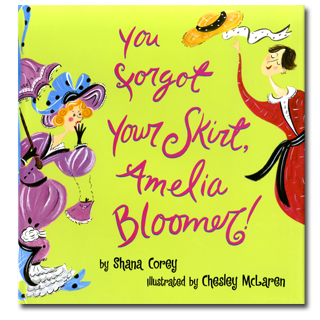
You Forgot Your Skirt, Amelia Bloomer - Shana Corey


"Thank goodness," they said. 
"Now everyone will forget this nonsense
and things can return to normal." 
But did people really forget about Amelia bloomer
and her improper ideas? 

This information book by Shana Corey (and illustrated by Chelsey McLaren) tells the story of the career of Amelia Jenks Bloomer, a women's rights activist and newspaper editor in the 1800's. I'll admit - I chose it mostly for the bright colors, the frilly dresses, and the subtitle, which was "You Forgot Your Skirt, Amelia Bloomer! - A Very Improper Story!" However, I was proven wrong. Although there are many frilly dresses in this book, the true reason for introducing those frilly dresses is to show how big of a deal it is when Amelia Bloomer chooses to give up wearing frilly dresses. 
Amelia Bloomer uses the phrase "What was proper about that?" throughout the first half of the book to emphasize how improper the actions that Amelia Bloomer performs are. She is the editor of a newspaper, which she names The Lily. How inappropriate for a woman to be the editor of a newspaper! She hated the dresses that women had to wear. She thought the dresses were inappropriate, and often uses the phrase "What was proper about that?" to describe the dresses themselves. Amelia's entire legacy rested on the fact that everyday, she asked the question, "What's proper about that?" whether it was about her clothes, about the rights that women didn't have at the time, or about the practicality of things. 
The REAL Amelia Bloomer
I think that this book also teachers children to question things and to embrace change, just like previous books (like The Giver and Among the Hidden), but not to the same extent. It's a book that has the potential to let children do these things at an earlier age, and I'm assuming that the target age audience of this book is early elementary. It would also serve as a fantastic resource in introducing historical figures in an interdisciplinary unit, as Amelia Bloomer was a women's rights activist, even if she ended up also being the woman responsible for introducing pants as a suitable bottom for women! (Hence the name bloomers, get it?). I thought this book was wonderful, and the author's note at the end is a history of Amelia Bloomer - from her birth in New York to her move to Iowa. One of my favorite quotes from the Author's Note is the very last sentence, which says: 
Today, women and girls can wear whatever they want. 
Perhaps it wouldn't be that way, though, 
if all those years ago Amelia Bloomer hadn't had the courage
to be "improper" and to take a stand
for something she believed in. 
Many books I don't consider worthy of reading the author's note, but this author's note not only adds to authenticity, but has the potential to spark even more interest in class-wide or individual research on women's rights. I think that that's research worth doing, and would love for all of the children in my class to enjoy and take interest in it.