What do you think now that you've gone and done it?
Does it make you look any better? Is this straight"
-- Momma flicked some more of Byron's hair back up porcupine-style --
"is this straight mess more attractive than your own hair?
Did those chemicals give you better-looking hair than me and your daddy and God gave you?
 |
| My silly daddy and I, giggling just like Kenny & his dad |
This was one of my favorite lines in this book. So powerful and encouraging of Momma to tell her children that they should be happy and content with themselves, just as they are. The Watsons Go To Birmingham - 1963 was completely different than I thought it would be. It made me feel as if I was a member of the Watson family. I hurt when Kenny hurt. I laughed when Byron did stupid things. I got annoyed when Joetta tattled on everything and everyone. I felt like Dad was a literary representation of my own father, who, when he doesn't have enough sleep turns into the giggly and silly man that Kenny's dad became at the end of the book on their family road trip to Alabama.
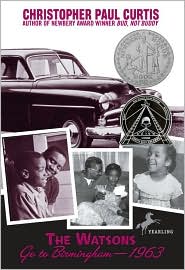 |
| The Watsons Go To Birmingham - 1963 |
This book had so many ups and downs and had two extremely dynamic characters in Kenny and Byron. The reader watches their relationship go from hatred and brotherly competition while they are in Flint to compassion and understanding when they are in Birmingham, and particularly when they head back to Flint near the end of the book. The most emotional portion of the book for me, and I assume, for other readers was the last third of the book that took place in Birmingham. The historical context for this book was extremely important, because without that context, we wouldn't be able to know the importance and gravity of the events that happen at the end of the book. The church bombing wouldn't be as painstakingly horrific (although it would still be horrific). We wouldn't feel as compassionate towards Kenny and his struggles when he moves in to the Watson Animal Hospital. We wouldn't be so touched by Byron's transformation and stepping up to the true role of a good big brother.
In a "Kid's Book Club Pick" article on NPR, they say -
"Teachers, librarians, and parents immediately embraced the book in part because Curtis so thoroughly captured the voice of a smarty-pants, pre-teen boy. But the book also found a passionate following because it provides a way for adults to guide children through difficult terrain, such as the violence of the Civil Rights Era and the racial hatred that claimed the lives of four little girls who died in the bombing." (Read the review here.)
I don't know if I necessarily expected the light-hearted beginning of the book to take such an emotional turn, but I enjoyed it regardless. And I completely agree with NPR in the fact that it takes some of the hard work out of figuring out a way as teachers to be comfortable with discussing the hard issues, like the Birmingham Church Bombing. Using this book as a scaffold to build up and talk about the gradual successes of the Civil Rights Movement and the difficult events that occurred, in my opinion, can help children have a person to identify with, even if Kenny is fictional.
And that is the power of historical fiction, just like Richard Peck discussed in his 2006 National Book Festival speech. What a wonderful power it is.
